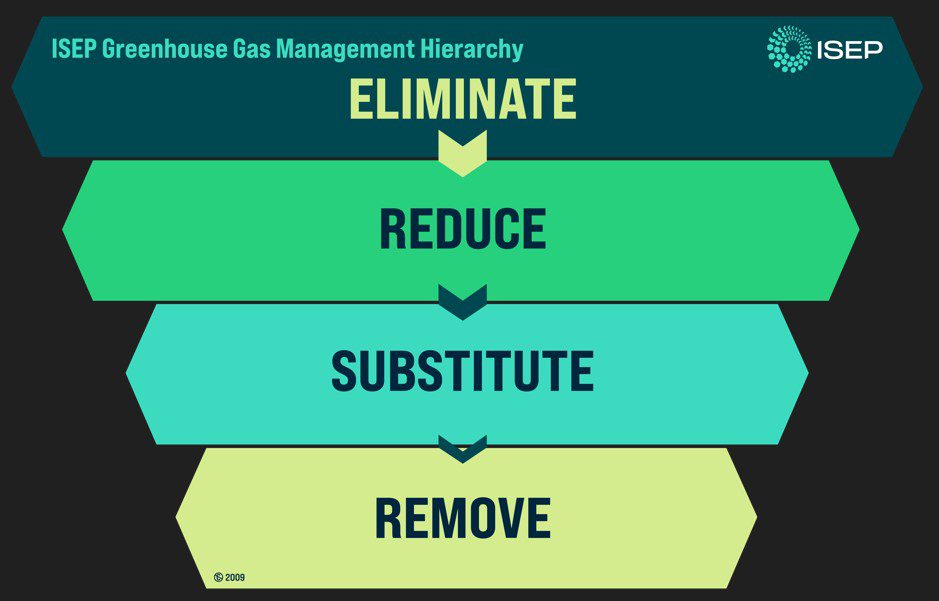
Since its introduction in 2009 by our professional governing body ISEP [1], the GHG management hierarchy has had to evolve with net-zero targets through the years, and its most recent update gives a structured framework for organisations to reduce their GHG emissions [2]. After being included in the UNFCCC Climate Neutral Now initiative in 2015, the hierarchy has grown to become globally recognised as a resource for prioritising and initiating meaningful climate action and is used by organisations around the world as a pathway to meeting their own climate goals. This latest evolution is the first update since the changes made in 2020.
The GHG Management Hierarchy in action
As an increasing number of businesses and organisations we work with here at SHIFT make the push towards a net-zero transition, the updates by ISEP are important. It is a free tool with case studies of the hierarchy being applied within organisations that have reaped the benefits of a well-structured transition plan to becoming more climate-friendly. The studies included do a good job of highlighting the different approaches available to obtain results when it comes to the 4 stages of the hierarchy. We’d suggest looking at these to see how this could assist in your decision-making process going forward.
Hierarchy Breakdown
1. Eliminate – Prevent GHG emissions entirely by changing models or operations.
2. Reduce – Improve efficiency in processes, energy use and operations.
3. Substitute – Switch to renewable or low-carbon technologies.
4. Remove – Balance residual emissions through removals or carbon credits.
ISEP are hoping the strategic impact of the update is to push towards proactive planning, rather than reactive offsetting, as well as helping businesses align with science-based targets and making sustainability a shared responsibility across the workforce, all while remaining consistent on the purpose of the hierarchy:
- Prioritising meaningful action.
- Supporting net-zero transitions.
- Standardising best practices.
Our ESOS, SECR, net-zero Carbon road-mapping and SHIFT reporting has led to some great results [3] with organisations and businesses that come back to us year on year, stating our reports have highlighted areas in which they can reduce energy usage or prompted change.
If you would like some practical advice on reducing environmental impacts or saving energy, please feel free to get in touch for a no-obligation 30 minute consultation. https://shiftenvironment.co.uk/contact/
[1] The Institute of Environmental and Sustainability Professionals https://www.isepglobal.org/
[3] https://shiftenvironment.co.uk/news/the-real-world-impact-of-shift-environmental-reporting/