What happens to your business when customers cannot afford your products, workers struggle to stay healthy, or trust in society starts to fray? Inequality is not just a social concern: it can affect the conditions businesses need to thrive.
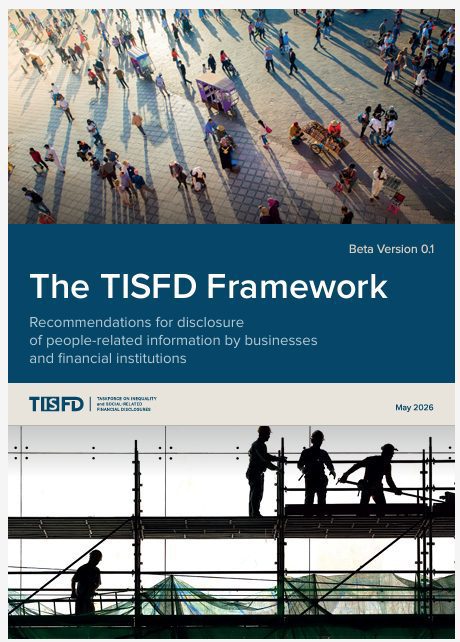
We have previously highlighted the Taskforce on Inequality and Social-related Financial Disclosures (TISFD) [1]. Its Beta Version 0.1 offers a first look at a framework designed to connect business impacts on people with the risks and opportunities businesses face [2]. It is a consultation draft, not a new mandatory reporting regime.
Look beyond the company boundary
The draft’s starting point is a two-way relationship: businesses affect people, but also depend on them. Workers’ skills and wellbeing, customers’ purchasing power and communities’ trust all help underpin business success.
Section 3.2 looks beyond individual companies to system-level risks. When harmful practices accumulate across an economy, they can weaken demand, productivity and social stability. A company can be exposed even if it did not create the underlying problem.
Climate and nature are part of this picture, too. The framework illustrates how losing coastal mangroves can expose both business premises and workers’ homes to flooding. The resulting disruption is not simply a property issue: it can affect the workforce on which operations depend.
What would businesses disclose?
The proposed general requirements cover five foundations:
- Materiality: identify relevant information about impacts, dependencies, risks and opportunities, using the applicable materiality definition—not just risks to profits.
- System-relevant information: consider the proposed approach to wider risks, with further guidance and metrics still to come.
- Stakeholder engagement: draw on meaningful, ongoing engagement with affected people and their representatives.
- Scope: explain coverage across operations and value chains, including changes from previous years.
- Time horizons: define the short, medium and long term.
The disclosure structure then follows four familiar pillars, aligned with the climate-focused TCFD and nature-focused TNFD: governance (who oversees the issues); strategy (what they mean for the business and its response); impact and risk management (how they are identified and monitored); and metrics and targets (how performance is assessed).
Metrics: the part we are watching
We love metrics—but they need to tell us something useful. This beta does not yet provide the recommended metrics and detailed disclosure recommendations for the metrics-and-targets pillar. Those are planned for later iterations; the draft schedules the final framework for the end of 2027.
What next?
Our takeaway? Treat this as a prompt to understand your relationships with people, not simply another reporting checklist. Start with who your organisation affects, who it depends on, and where better wellbeing could strengthen resilience.
If you are exploring social sustainability, we suggest drawing inspiration from the science of measuring wellbeing [3]. And because people and climate risks overlap, please get in touch about our carbon footprinting and building-portfolio climate-risk assessments.
[1] https://shiftenvironment.co.uk/news/update-on-social-related-financial-disclosures/
[2] https://www.tisfd.org/frameworks/tisfd-framework-beta-version-0-1
[3] https://shiftenvironment.co.uk/what-is-shift/social-sustainability/