
Introduction
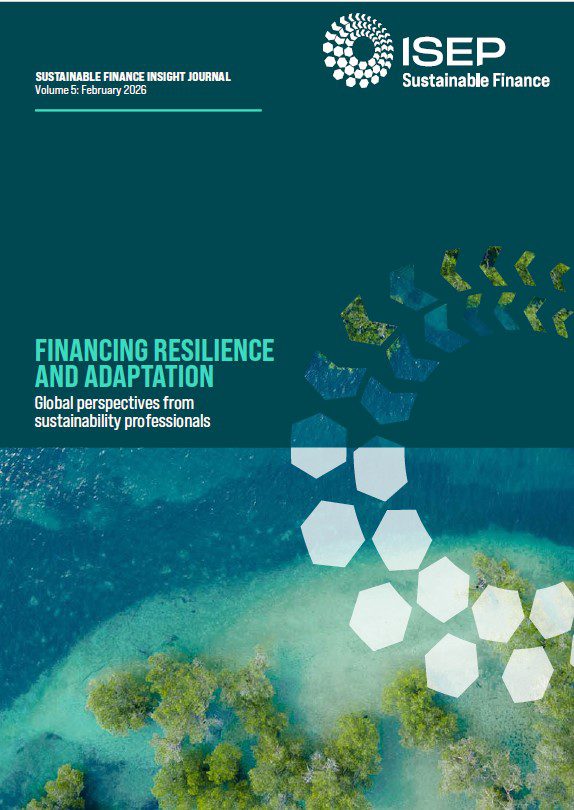
Our professional institute, ISEP, has recently issued a document about financing adaptation to climate change [1]. The key takeaways are:
- Adaptation finance is now central – Climate adaptation has emerged as a core component of resilient economic systems, driven by the recognition that physical climate risk is financial risk.
- Resilience can be investable and measurable – Case studies across housing, infrastructure and asset valuation demonstrate that avoided losses and reduced risk can translate into clear financial value.
- Nature-based solutions function as infrastructure – Ecosystems such as mangroves, agricultural landscapes and restored coastlines can deliver resilience, biodiversity and social benefits when supported by appropriate financing models.
- Policy frameworks matter – Enabling regulation, fiscal integration and strategic planning are critical to mobilising private capital and embedding adaptation into mainstream investment decisions.
- Human resilience underpins systemic resilience – Sustained progress depends not only on capital and data, but on the wellbeing, collaboration and narrative capacity of sustainability professionals themselves.
The document contains several articles (including one by us – see below) which challenge the assumption that adaptation cannot be monetised. By focusing on avoided losses, reduced volatility and long-term asset performance, they show how resilience can be translated into financial value. Others remind us that nature-based solutions (when supported by inclusive governance and appropriate financing structures) can function as critical infrastructure, delivering social, environmental and economic returns simultaneously.
Social housing example – SHIFT Environment contribution to the document
There are ~5 million social homes in the UK and around half of them are owned and managed by Housing Associations, with the remainder owned and/or managed by councils or arms-length organisations.
The three main adaptation issues affecting social homes are flood, overheating and water stress. Unlike owner occupied homes, there is a split incentive to upgrade the homes. For Housing Associations, the landlord invests the money to adapt the homes, but there is no financial mechanism for them to reap the benefits of this investment. Currently there is no funding for adaptation, and a novel approach is required.
There is sporadic funding for energy efficiency upgrades, but no long-term sustainable finance for either energy efficiency upgrades or adaptation measures. Therefore, this novel finance model is proposed.
The proposed mechanism
In brief the proposed mechanism is:
- Landlords raise money from their own preferred sources – e.g. reserves or from ESG funding – investors are very keen to lend ESG money to Housing Associations.
- They proceed at their own pace to make homes sustainable – the definition of sustainable to evolve, but could be a home that is water efficient, resilient to overheating and flood, as well as net zero ready. Adaptation measures could be carried out at the same time as energy efficiency upgrades. This will reduce disruption for residents and reduce implementation costs for landlords.
- Once the home is made sustainable, landlords receive an annual amount from Government for, say, 25 years which will go to pay back the original investment
The mechanism follows the same method as a new funding model for energy efficiency upgrades which was widely accepted as an “investable” idea from finance directors, investors and the Green Finance Institute [2].
Advantages of this approach
For Housing Associations:
- There is a clear financial incentive for a landlord to upgrade homes such that they are adapted to climate change.
- Can be done at the same time as other upgrade works.
- Avoids burdensome pre-works funding applications – many landlords have highlighted that the application process for the sporadic energy efficiency upgrades is time consuming and, even if a bid for funding is successful, it is very difficult to stick to the delivery timelines. This has led to some landlords giving the money back to Government and upgrade works not being done.
- The proposed model generates a steady and predictable income stream
- Residents benefit quicker because landlords no longer have to wait for big funding rounds.
Further reading
Our article continues with advantages of this approach to Government as well as some benchmarking data on adaptation from ~40 UK social landlords.
There are also some great articles on:
- how financial institutions are channelling funds towards climate adaptation
- building climate resilience with nature
- developing business cases for financing nature-based resilience in the global south
- quantifying physical climate risks to infrastructure investments
- seven practical insights into funding landscape regeneration
- personal resilience for sustainability professionals
About SHIFT Environment
SHIFT Environment specialises in environmental reporting for UK social landlords. We work with 60+ landlords in England, Wales and Scotland and have been doing so since 2008. As well as reporting on adaptation, SHIFT Environment also does carbon footprints, SECR and ESOS reporting. Please contact us if you would like an initial discussion about these services: [email protected]
Notes
[1] The document is entitled, “Sustainable Finance Insight Journal volume 5: Financing resilience and adaptation” and can be downloaded from here: https://www.isepglobal.org/resources/blogs/2026/february/sustainable-finance-insight-journal-volume-5-financing-resilience-and-adaptation/
[2] Finance directors from 6 different housing associations representing over 180,000 homes; 4 different investors representing around £40 billion invested in the social housing sector; A representative from the Green Finance Institute – write up is here: https://shiftenvironment.co.uk/wp-content/uploads/2024/06/Funding-net-zero-roundtable-of-the-willing.pdf