

It’s the most wonderful time of the year… and also the most expensive. From novelty jumpers to panic-bought gift sets, December has a funny way of emptying wallets faster than you can say “Is that returnable?” Which raises a timeless festive question: can you actually buy a happy Christmas?
To investigate, a shiny new dataset [1] reveals how much each UK region spends per person on Christmas festivities. This was then paired up (rather festively) with the latest ONS wellbeing statistics [2] to see whether festive spending and life satisfaction are secretly holding hands under the mistletoe.
First, let’s put all our baubles on the table. The raw data shows which regions are splashing the most cash, and which are topping the charts for life satisfaction. Some regions are clearly going all-in on Christmas; others appear to be taking a more “mulled wine and a nice walk” approach.
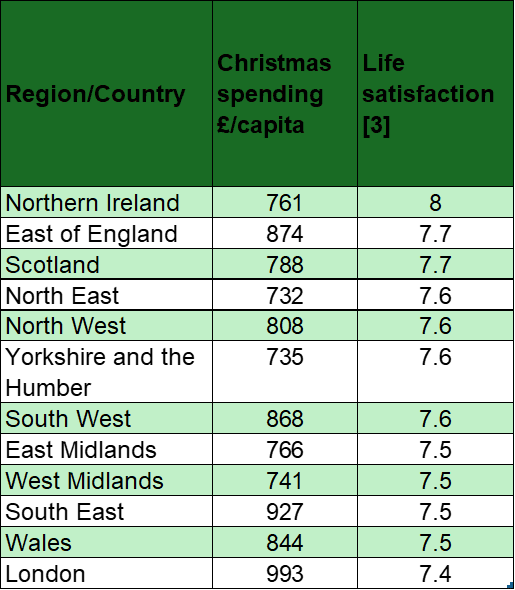
Then comes the fun bit: the correlation.
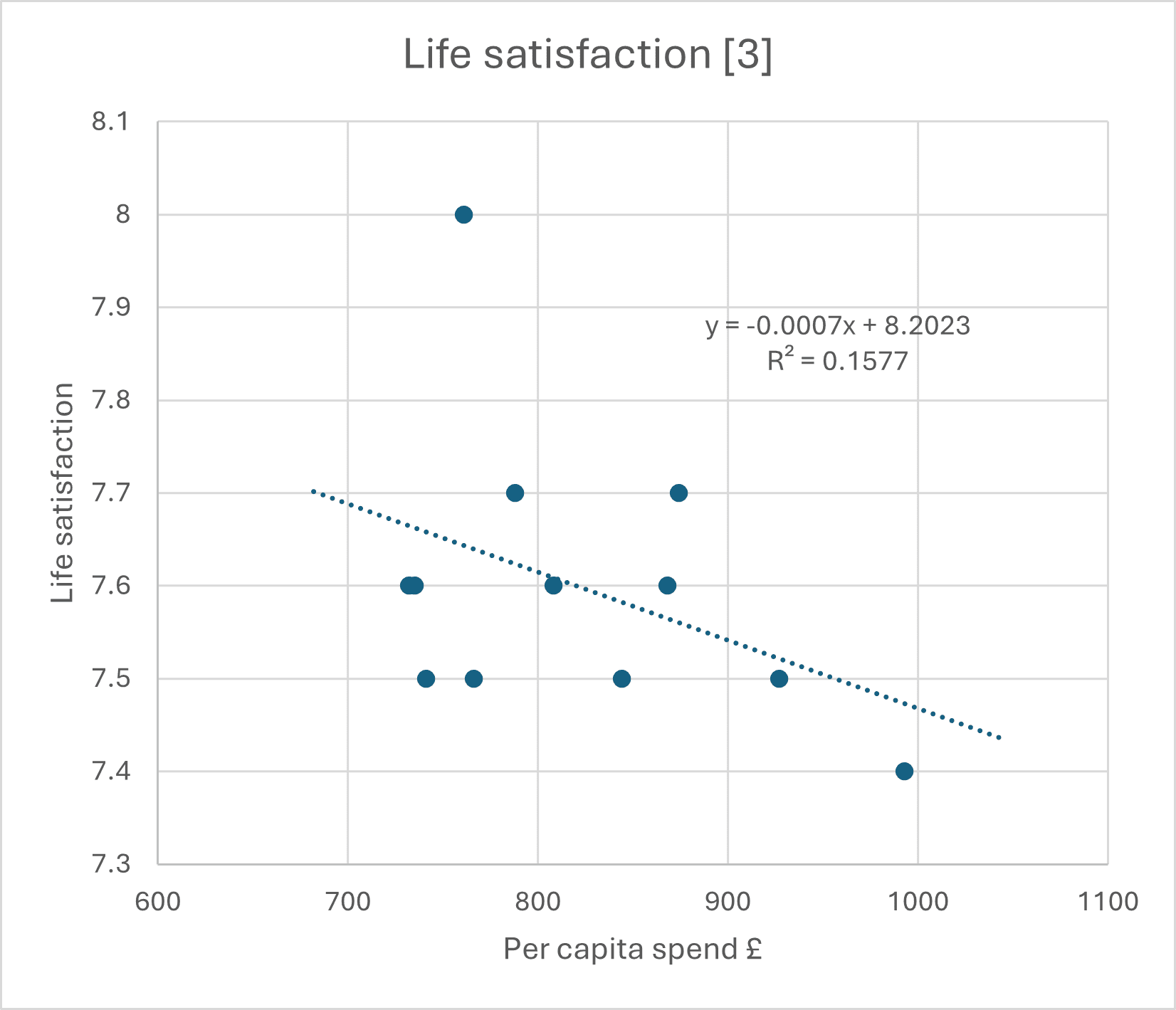
At first glance, it looks like there’s a negative relationship between spending and happiness. Yes, you read that right. The more we spend, the less satisfied we seem to be. According to this very festive bit of number-crunching, a cheaper Christmas might actually be a happier one. Excellent news for both your bank account and the planet—especially if less spending means fewer gifts destined for the cupboard of forgotten gadgets. [4].
It gets better. If we boldly extend the trend line all the way back to a Christmas with £0 spent, we land on an impressive life satisfaction score of 8.2 out of 10. That’s enough to out-cheer even our famously content Scandinavian friends [5]. No flat-pack furniture required.
Naturally, this leads to an even more important question: how much would we need to spend to achieve a perfect 10 out of 10 for life satisfaction?
The answer, delightfully, is minus £2,568. In other words, peak Christmas happiness would require someone to give us that amount of money. Which rather undermines the old saying that it’s better to give than to receive—at least according to our very tongue-in-cheek festive maths.
Now, before anyone cancels Christmas altogether, a note for the sharp-eyed (and statistically savvy) among you: the correlation coefficient is extremely low. Translation? There’s probably no meaningful relationship here at all. Christmas joy, it seems, stubbornly refuses to be explained by spreadsheets.
But still—whether you’re spending big, spending small, or spending nothing at all—there’s one conclusion we can all agree on:
Have a very Happy Christmas anyway.
[3] To derive estimates of life satisfaction, respondents were asked “Overall, how satisfied are you with your life nowadays? Where 0 is ‘not at all satisfied’ and 10 is ‘completely satisfied'”. For this blog, we’ll call life satisfaction, “happiness”.
[4] For more on the link between environmental protection and our long term wellbeing see “Happiness by Numbers”
[5] https://shiftenvironment.co.uk/news/happiness-in-the-uk/
Photo by erin mckenna on Unsplash